

In the previous lesson, you learn why a word in Arabic that is composed of the same letters can have multiple different meanings. The word سلم is composed of س, then ل, and finally م. Their shape in isolation is slightly different from their shape in a word. In this lesson, we will learn how […]

Arabic is a right-to-left language, and it is cursive. When letters are connected, their shapes change. That is, each letter has three shapes: one at the start of the word, one in the middle of the word, and one at the end of the word. This table shows the shape of the letter baa ب.

Arabic is a right-to-left language, and it is cursive. When letters are connected, their shapes change. That is, each letter has three shapes: one at the start of the word, one in the middle of the word, and one at the end of the word. This table shows the shape of the letter Taa ط.

Arabic is a right-to-left language, and it is cursive. When letters are connected, their shapes change. That is, each letter has three shapes: one at the start of the word, one in the middle of the word, and one at the end of the word. Like the daal د and the dhaal, however, the raa ر, shown in this table, has only two shapes because it does not connect to subsequent letters.
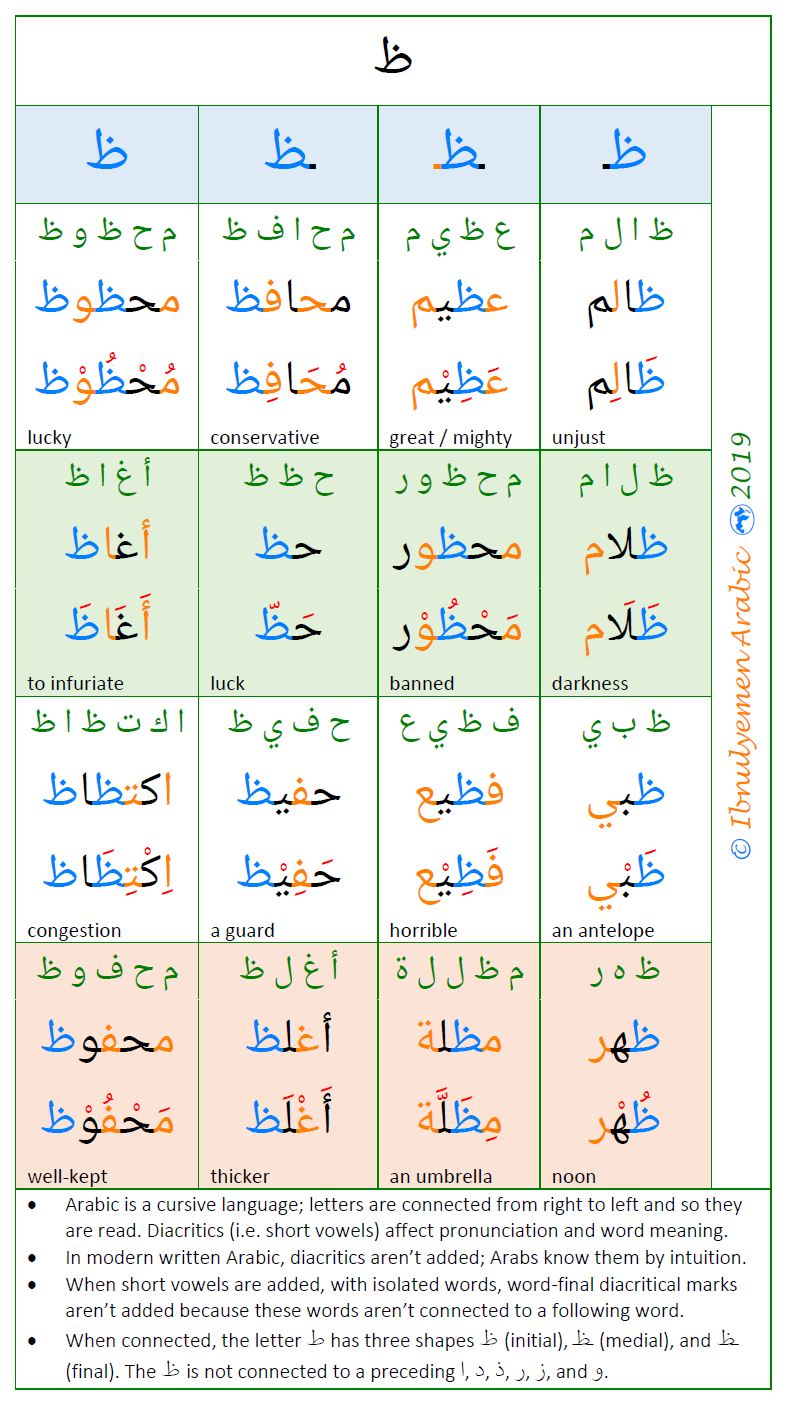
Arabic is a right-to-left language, and it is cursive. When letters are connected, their shapes change. That is, each letter has three shapes: one at the start of the word, one in the middle of the word, and one at the end of the word. This table shows the shape of the letter Dhaa ظ.

Arabic is a right-to-left language, and it is cursive. When letters are connected, their shapes change. That is, each letter has three shapes: one at the start of the word, one in the middle of the word, and one at the end of the word. However, the daal د, shown in this table, has two shapes because it does not connect to subsequent letters.

Arabic is a right-to-left language, and it is cursive. When letters are connected, their shapes change. That is, each letter has three shapes: one at the start of the word, one in the middle of the word, and one at the end of the word. Like the daal د, however, the dhaal ذ, shown in this table, has two shapes because it does not connect to subsequent letters.

Arabic is a right-to-left language, and it is cursive. When letters are connected, their shapes change. That is, each letter has three shapes: one at the start of the word, one in the middle of the word, and one at the end of the word. This table shows the shape of the letter nuun ن.

Arabic is a right-to-left language, and it is cursive. When letters are connected, their shapes change. That is, each letter has three shapes: one at the start of the word, one in the middle of the word, and one at the end of the word. This table shows the shape of the letter miim م.

Arabic is a right-to-left language, and it is cursive. When letters are connected, their shapes change. That is, each letter has three shapes: one at the start of the word, one in the middle of the word, and one at the end of the word. This table shows the shape of the letter yaa ي.

Arabic is a right-to-left language, and it is cursive. When letters are connected, their shapes change. That is, each letter has three shapes: one at the start of the word, one in the middle of the word, and one at the end of the word. This table shows the shape of the letter khaa خ.

Arabic is a right-to-left language, and it is cursive. When letters are connected, their shapes change. That is, each letter has three shapes: one at the start of the word, one in the middle of the word, and one at the end of the word. This table shows the shape of the letter laam ل.

Arabic is a right-to-left language, and it is cursive. When letters are connected, their shapes change. That is, each letter has three shapes: one at the start of the word, one in the middle of the word, and one at the end of the word. This table shows the shape of the letter shiin ش.

Arabic is a right-to-left language, and it is cursive. When letters are connected, their shapes change. That is, each letter has three shapes: one at the start of the word, one in the middle of the word, and one at the end of the word. This table shows the shape of the letter siin س.


Arabic is a right-to-left language, and it is cursive. When letters are connected, their shapes change. That is, each letter has three shapes: one at the start of the word, one in the middle of the word, and one at the end of the word. This table shows the shape of the letter qaaf ق.

04.arabic writing for beginners - Download as a PDF or view online for free

Contenu : 26 fiches, sur chacune des lettres de l’alphabet pour apprendre le tracé des lettres en CP. Faisant suite au travail engagé récemment, qui m’avait amené à partager des affiche…

Free Printable Cursive Writing Worksheets - cursive alphabet, cursive letters, cursive words, cursive sentences. Practice your penmanship with these handwriting worksheets from K5 Learning

Learn German cursive handwriting with easy to follow instructions, worksheets and#CursiveAlphabet #HandwritingGoals #PenmanshipPractice #CalligraphyInspiration #BeautifulScript

Arabic Cursive Writing Practice offers a clear PDF guide with strokes and worksheets to help beginners improve their Arabic handwriting skills. Focused on Arabic writing basics and script practice, this resource is ideal for those learning Arabic script. Save for future practice or educational use. #ArabicWriting #Calligraphy #Printable


Cursive handwriting is a new experience that many students are excited about. for most students, they have seen cursive handwriting before from teachers or parents and are very excited about the opportunity to learn cursive handwriting. below, you’ll find cursive writing tips to help harness that excitement in order to help students excel at learning ... Read more

#CursiveFonts #HandwrittenType #CreativeFonts

